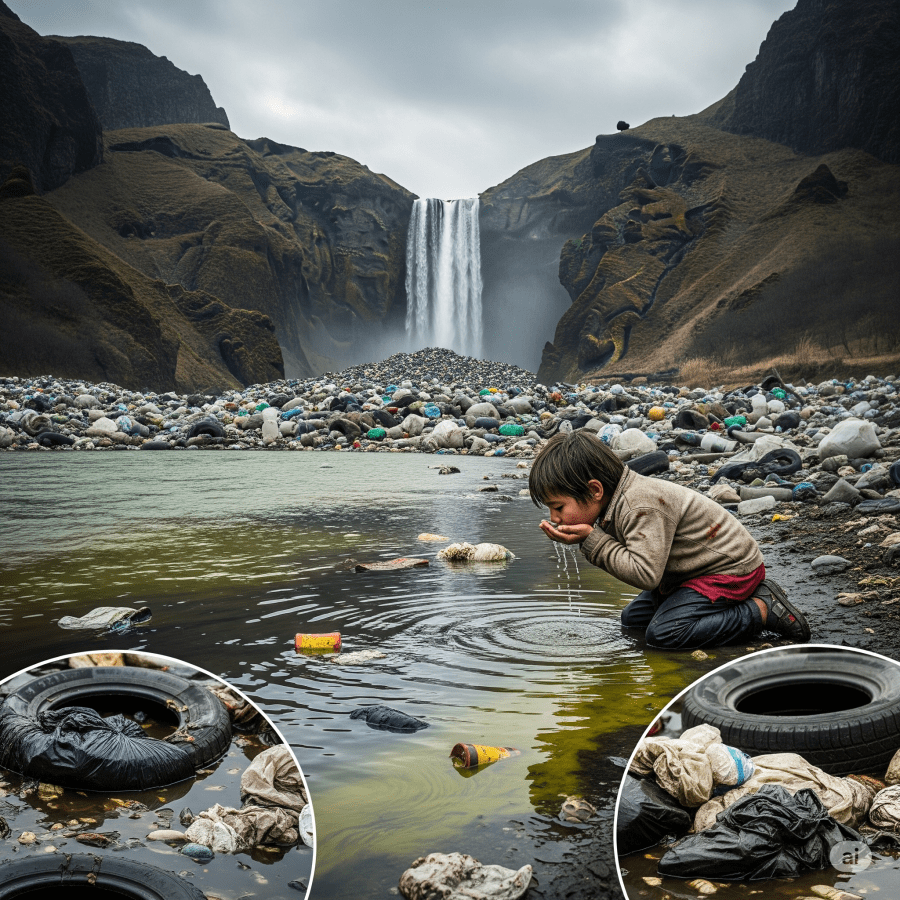
The breath gifted to us by God now carries the stench of our own corruption. The waters—once pure for drinking, bathing, and nourishing the soil—run with toxins. Even the food meant to sustain life is laced with poison. We have defiled not only the earth beneath us, but the heavens above: debris orbits our planet like a testament to careless ambition. Litter is no longer shocking—it’s expected. Yet the desecration goes deeper still. We have learned to pollute even the sacred: the word of God, twisted by tradition and clouded by bias, no longer flows freely. Creation groans under the weight of our defilement.
The voices of our teachers and traditions have grown so loud, they’ve all but drowned out the very words we claim to hold sacred. Yeshua warned us plainly:
“Do not think that I have come to abolish the Law or the Prophets. I have not come to abolish but to fulfill. Truly I tell you, until heaven and earth pass away, not the smallest letter, not the least stroke of a pen, will by any means disappear from the Law until everything is accomplished. Therefore, whoever breaks even the least of these commandments and teaches others to do the same will be called least in the kingdom of heaven. But whoever practices and teaches them will be called great. For I tell you, unless your righteousness surpasses that of the scribes and Pharisees, you will never enter the kingdom of heaven.”
—Matthew 5:17–20
To abolish the Law and the Prophets is to silence the voice, the mind, and the will of God Himself. The Torah given through Moses was not his own invention—it was divine instruction. The Prophets did not speak from personal insight—they echoed the words of God. They warned of judgment and pleaded for repentance because the people had forsaken Moses.
“And the LORD commanded us to do all these statutes, to fear the LORD our God, for our good always, that He might preserve us alive, as it is this day. And it shall be our righteousness, if we observe to do all these commandments before the LORD our God, as He hath commanded us.”
—Deuteronomy 6:24–25
True repentance is not a feeling—it is action.
Fearing the LORD is not a sentiment—it is action.
Obedience is not theory—it is action.
Yet today, the word and authority of God have been so polluted that questioning human authority is seen as heresy—as if man’s word outweighs what is written.
Some traditional Jewish perspectives reject the New Testament entirely, branding it as blasphemy. But the teachings of Yeshua echo the heart of Torah:
“Let us hear the conclusion of the whole matter: Fear God, and keep His commandments: for this is the whole duty of man. For God shall bring every work into judgment, with every secret thing, whether it be good or evil.”
—Ecclesiastes 12:13–14
It’s time to stop polluting the perfect word of God with our traditions, biases, and personal beliefs.
It’s time to return to the source.
What did Moses command? That is where we begin.
We stand at a crossroads—between polluted tradition and pure instruction, between inherited noise and divine clarity. The earth groans, the heavens bear witness, and the sacred text cries out to be heard again. Yeshua did not come to erase the foundation, but to illuminate it. Moses did not speak from opinion, but from revelation. The Prophets did not invent warnings—they delivered them.
If we are to walk in righteousness, we must return—not to systems built by men, but to the commandments given by God. Not to interpretations clouded by bias, but to the voice that thundered at Sinai and whispered through Yeshua’s words.
Let us strip away the layers of tradition that obscure truth. Let us repent in action, fear God in obedience, and honor His word with integrity. The restoration begins not with innovation, but with remembrance.
Return to the Torah.
Return to the Prophets.
Return to the Messiah who fulfilled—not abolished—the Word.
And in doing so, return to the heart of God.
Summary
This piece is a call to return to the purity of God’s word and commandments. It highlights how humanity has polluted not only the physical world—air, water, food, and space—but also the spiritual realm by distorting Scripture through tradition and personal bias. Quoting Yeshua and the Torah, the writing emphasizes that true righteousness is rooted in obedience, not in religious systems or human authority. It critiques the tendency to elevate tradition above divine instruction and urges readers to rediscover the original commandments given through Moses and affirmed by Yeshua. The message concludes with a plea to repent through action and to restore the integrity of God’s word by returning to its source.

 Torah Road